Translate

Sunday, May 13, 2012

The Hood

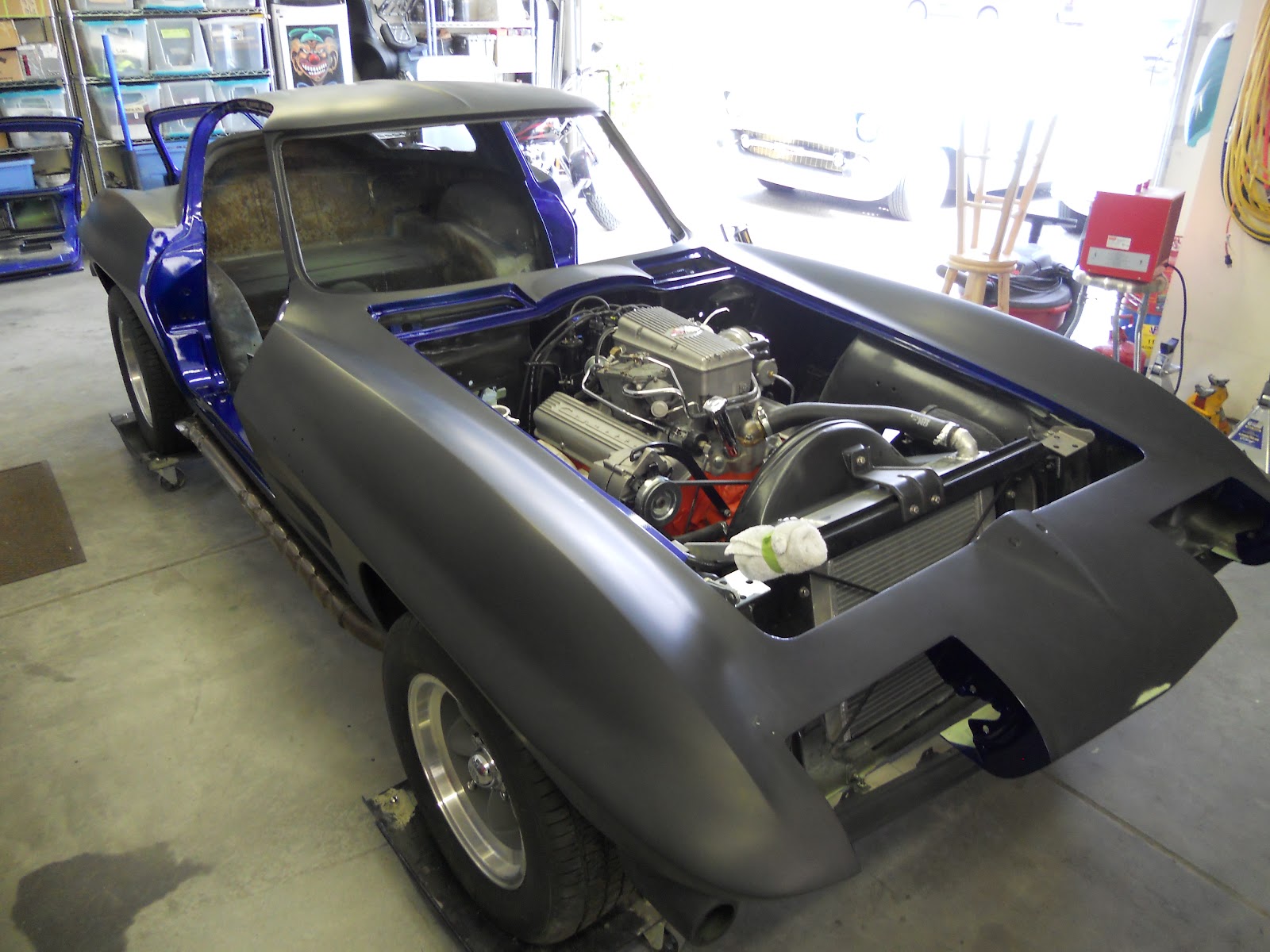
Over the last year we have spent many hours repairing this 1963 hood.  The hood was bought locally and it had lots of issues.  Not only had it been in a head-on collision, the tow company used a reciprocating saw to remove the hood from the wreckage.  It was ugly.


Over the last few weeks I've been working on both sides of the hood.  This includes grinding, fiberglassing and sand blasting.  All the work was structural, nothing cosmetic. 


You can see some repairs made to the top of the hood... 


But most of the repairs were made to the underside.  There were many cracks and holes all of which needed attention.  This is a representative repair that was stuffed, plugged, ground then later laminated with fresh fiberglass.  There were several of these.


This was a soft edge that needed to be built up then ground down to restore the edge. 


When the repairs were complete it was off to the sandblaster to remove more of the old paint.  200 pounds of sand were used in total.


It turned out nice.  In this picture there are at least a dozen repairs.  It's looking good.


Here's the fuzzy hood I mentioned in the last post.  It's paint remover hard at work.  It removed about 70% of the old paint, the remainder required sandblasting and hours and hours of hand sanding. 


It took a long time to get to this stage.  The good news is the hood is structurally sound and I have no issues using this hood on our 63 Corvette.


The bad news is we haven't  even started the finish work... Bondo, green primer, block sanding, etc.   


Thanks for watching.

Sunday, May 6, 2012

The Doors - Part 2 (with a Post Script)

The primer has been drying for a full week so it's time to guide coat.


A contrasting primer was lightly sprayed and allowed to dry.  I used my 6" DA (dual action) sander on the large flat areas.  In this picture I just finished the lower half of the door.


I changed to a 3" sanding disc to do the curved areas.  This includes the area above the center line and the very top of the door.  Care must be taken not to sand any edges or corners with the DA otherwise you'll likely sand through the primer.


Hand sanding was next and that was followed up with a maroon scuff pad.  Fortunately we didn't sand through the primer so we are ready for the primer sealer.


I used a wax and grease remover and a post sanding cleaner before painting.  These products are recommended by House of Kolor so I use them.  A couple coats of primer sealer was applied to both doors.


I am certain hanging the doors is a two man job but I was able to do it alone using my motorcycle lift.  I put a padded Lazy Susan on top of the lift then jacked the door up to height.  It worked great.  Two would have been better but this worked fine.


It took a few hours to hang both doors.


All the body work really paid-off.  I am sure this fit is better than the 1963 factory fit.


It's sexy.


The primer sealer will be allowed to dry then I'll scuff the paint to match the rest of the car.

Admittedly, there are a couple areas on the doors that require attention.  There is one spot on the driver side door that doesn't transition well to the body.  It's only about 2 inches long but it will need to be stripped back to bare fiberglass for a proper repair.  The other area is just a general clean-up of all the door to body joints.  You can see some of it in the photo above.  Cleaning up the joints will only require a few swipes of the sandpaper but that act will require us to rethink how the inside lip of the doors will be painted.

I am also working on the hood so I'll post pictures of it soon.   Be forewarned, it's fuzzy...


Post Script


Here are pictures of the repaired transition area.  This is a blurry photo but it shows how the body line doesn't transition well between the door and the body.  The body line on the door became soft from too much sanding.  The door is on left side of the picture.


I decided to make the repair using our Icing finishing putty.   I protected the body with tape then bridged the gap using a plastic spatula.  I cut the putty at the gap with an Exacto knife just as it started to set.


The transition between the body and the door is now very nice and the body line is identical on both sides.

Sunday, April 29, 2012

The Doors

I spent the last couple months looking at the inside of the doors admiring all the work we've done which included the paint job.  When I finally turned the doors over I was shocked to see how little work had been done on the exterior.  I even spotted a crack in the bonding agent that will need to be fixed.


I grabbed the grinder and removed the crack until it was almost gone with exception to just a very thin amount on the back side of the panel.  I always try to leave a little something for the new fiberglass and resin to rest against.  It acts as a form.


Before I get too carried away with the grinding, sanding and painting I thought it best to protect all the work that's been done on the inside of the doors.  Masking tape and masking paper was just the ticket.


I spent several hours the last couple weeks getting the doors in the condition shown below.  All the fiberglass work is done, the skins were guide coated and the low spots were filled in where necessary.  The outside window openings were then masked off in preparation for paint.  Take note of how little of the green primer remains after all the body work.


Last weekend I applied 2 to 3 coats of two-part epoxy primer then I set the doors aside and allowed them to dry for 1 week.


This weekend I guide coated the doors again.  I find it best to use a contrasting primer for the guide coat, not a glossy paint, but a primer.  The reason is because the glossy paint gums up the sandpaper where the primer will not.


Now that the second guide coat is done you can see how much more of the green primer is left on the doors.  That means the doors are getting flatter.  There are still areas where fiberglass is showing so the doors will need another coat of primer.


And here they are with their third coat of primer.  I painted these this weekend so they will have to dry for about a week before I can guide coat them again.  They really look good and I suspect one more guide coat should do it.


Look who showed up!  Ty and his wife Bonnie flew into town a few days ago and Gerri and I got to spend an evening with them.  Not one too miss out on working in the garage, Ty grabbed a rag and polished the blue paint.  Yes it was mostly for the photo but it was still good to see Ty back in the garage.  


While the doors dry I'll start doing similar work to the hood.  The hood as you recall is in need of a lot of TLC.  Fortunately, we have the know how and I am prepared to spend many hours making it right.

Thanks for watching.

Sunday, April 22, 2012

Portland Swap Meet - 2012

Dennis K and I attended the Portland Swap Meet last week.  It was huge as usual.  Here are 3 noteworthy tidbits worth sharing:

1.  I bought 4 signed 1963 Corvette related lithographs that I know little about.  They were previously framed so the edges are not perfect but they do have significant original signatures.  All four are signed by  Zora Duntov and Larry Shinado, two very well know names associated with the Corvette.  You can read about them here: http://corvettes.about.com/od/history/tp/All-The-Kings-Men.htm .  Some have a third signature (I think).  I suspect they have value but I really know nothing about them.  If any of you know anything about these I would welcome information.  Here are pictures of each:


2.  I win.  I spent more money than Dennis at the swap meet.  Unfortunately,  I am now a hoarder.  Between Gerri and I we now have 6 vehicles and a motorcycle.  But check out our new acquisition, a 1971 VW bug.  Yes it's Gerri's and no I don't fit behind the wheel.


3.  I spoke with Gary Hodges, one of the few people I consider very knowledgeable about early Corvette mechanical fuel injection units.   Gary shared some valuable information with me and I capture it in this video update.   Check it out here:


I added a post a couple days ago about painting the door and hood jambs.  If you've not checked this web site recently you might have missed it.  Be sure to check it out.

Door skins are next!  I promise.

Friday, April 20, 2012

Painting the Hood and Door Jambs

Fresh catalyst was recently delivered, the car is fully masked, and we are ready to paint.  The black primer sealer was scuffed and wiped down with a post sanding solution about a week ago so all it needs is a quick wipe down with a tack cloth.  Let the painting begin!


The second coat of black primer sealer was applied per the HOK tech sheet.  I sprayed the door jambs, hood jamb, headlight bucket recesses, rear valance recess and the inside of the fuel filler recess.


After 1 hour of drying time, two coats of Lapis Blue were applied.  Lapis Blue has the pearl/metal flake.  It goes on in medium coats and is applied very thin.  This is not a heavy build paint.


Lapis Blue was followed by the Cobalt Blue Kandy.  The application instructions for Kandy are very specific.  "Apply 5 to 6 coats to achieve proper color.  Start with 3 medium wet coats first, with 75% spray overlap.  Finish with 2 to 3 full wet coats with 50% spray pattern overlap." If we don't do it this way we will most likely get streaking.  In this picture we just finished the first 3 coats.


Here are the last 3 coats.  With each coat it gets darker and richer.


3 medium coats of clear were then applied.  After the paint dried to the touch I removed the masking.  The paint is pretty spectacular if I do say so.  Double click the photo for a closer view.  It's very nice!


Later in the day I removed all the plastic and admired our work to date.   It's a beautiful thing.

The Portland Swap Meet was last week.  Stay tuned for an update on what we found and what we learned.

Sunday, April 15, 2012

Door Edge Paint Repairs

After the doors were painted last year the rubber moldings were glued in place then the doors were hung so we could work on fitment.  The doors were aligned as best as possible then the body work started.  We fiberglassed some areas and used Bondo in others.  All of this work affected the door edges and now the edges need to be repainted.


  I used a Dremel with a flapper wheel to smooth out the big bumps. The edges were then sanded until smooth.


Some areas were worse than others.  This area had both Bondo and fiberglass.


As was done on the body, the doors were masked to prevent overspray.


A maroon scuff pad was used to remove any remaining gloss.


I used an Iwata C airbrush for all the painting.  Here I am applying the black primer sealer.


The primer sealer was followed by the Lapis Blue, Cobalt Blue Kandy and several coats of clear.


The masking was removed revealing a very nice repair.


There is a fine lip at the edge of the repair.  After this drys for a few days I'll wet sand the edges then buff it back to a bright gloss.


I am pleased.  If it had not turned out this nice I would have had to mask the rubber molding then reshoot the entire door.  This is good though.  It's very nice.

Cool Desert Nights is only a couple months away.  Hopefully we will have the exterior of the car assembled and painted by then.  It's an aggressive expectation but we'll give it a try.